We carry no AI product, take no software margin, and have nothing to lose by telling you to wait. This page is what we actually tell clients: what is worth deploying now, what to pilot with a hand on the brake, and what is being marketed years ahead of where it works.
Almost every AI conversation starts with features. The one that actually decides your options is simpler: when you switch this on, your customer calls leave your building. Here is the trip they take.
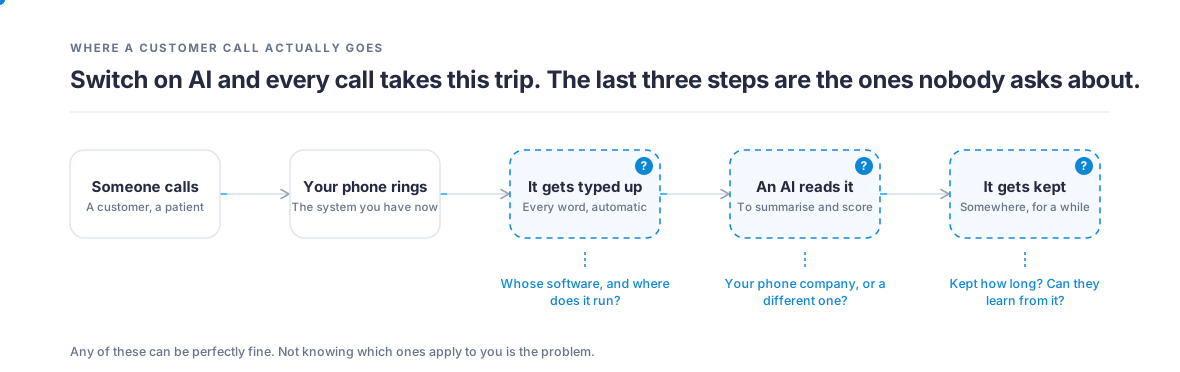
Most companies can answer the first two steps and go quiet on the last three. That is normal - the answers live in a contract nobody has read since signing. We will walk your stack and find them with you, in about an hour, at no cost.

Most AI readiness tools are a lead form wearing a quiz. This one scores you, tells you which of the three categories below you belong in, and names the specific thing blocking you - on screen, before there is any email field.
The honest constraint on adopting AI is rarely the AI. It is the phone platform underneath it, where your data sits, and whether anyone owns the decision. That is what this asks about.
Same three buckets we use on a call. Nothing here is hedged to keep a vendor happy, because we do not have one.
Handles the calls that currently go to voicemail or ring out. Quality is good enough now that callers largely do not fight it, and the value shows up in the first month. Test it against your own recordings, not a demo.
Every call transcribed and summarized into the CRM without anyone typing. The time saving is real and immediate. Confirm where recordings are stored before you enable it if you are in healthcare or financial services.
Instead of a supervisor spot-checking two percent of calls, every call gets scored against your criteria. This is the one that usually surprises people with how much it changes coaching.
Mature, cheap, and genuinely useful in a contact center or any multilingual workforce. Low risk to try.
Booking, rescheduling, processing a return. The technology works; the problem is what happens on the ten percent it gets wrong. Pilot on one workflow with a human check before you let it touch anything billable.
Accurate enough to be useful, not accurate enough to be the only input. Use it to prioritize a queue, not to close a ticket.
Anomaly detection is real and helpful. "Self-healing" is mostly marketing for automated failover that already existed. Ask exactly which actions the system takes without a human, and get it in writing.
The output quality depends almost entirely on how clean your data is. Most disappointing pilots we see are data problems wearing an AI costume.
The platform underneath is the actual constraint. Fix that and the AI options open up on their own, usually at lower cost. This is the single most common thing we steer people off.
The consent and disclosure rules are moving faster than the products. Several states now require disclosure, and the FCC has ruled AI-generated voices in robocalls illegal. Not worth the exposure yet.
This market is repricing every few months and capability is moving fast. A three-year per-seat commitment made today will look expensive by year two. Twelve months maximum, with a right to renegotiate.
Every AI vendor demo is run on curated data. Run yours on a bad week of your own calls before anyone builds a business case on it.
Useful mainly for one reason: it tells you what not to sign today. We have labelled how sure we are, because a forecast without that is just an opinion in a suit.
The use case that pays for itself is different in a plant than in a law firm, and the thing that blocks it is different again.
After-hours triage and appointment reminders are the clear wins. The blocker is almost always transcription: confirm PHI handling, storage location and whether a BAA covers the AI vendor specifically, not just the phone platform.
Anomaly detection on plant connectivity earns its keep, because a line going down has a number attached. Voice AI matters less here than reliable failover that actually works.
Call summarization and intake handling save real hours. Confirm confidentiality terms and whether your inputs train the vendor model - for privileged material that is the whole question.
Overflow answering across locations is the practical win. Be skeptical of "AI-managed" networking claims; ask what actions run without a human.
Recording, retention and supervision rules govern what you can enable. Get compliance in the room before the pilot, not after it.
Notes, summaries and CRM hygiene are the fastest payback in any business that bills for time. Low risk, quick to prove.
We sell no AI product and take no software margin, so "not yet" is an answer we are free to give - and we give it often.